.svg)
.png)
%201.png)


Managing Merchant Credit Risk: Strategies for Payment Companies
merchant credit risk
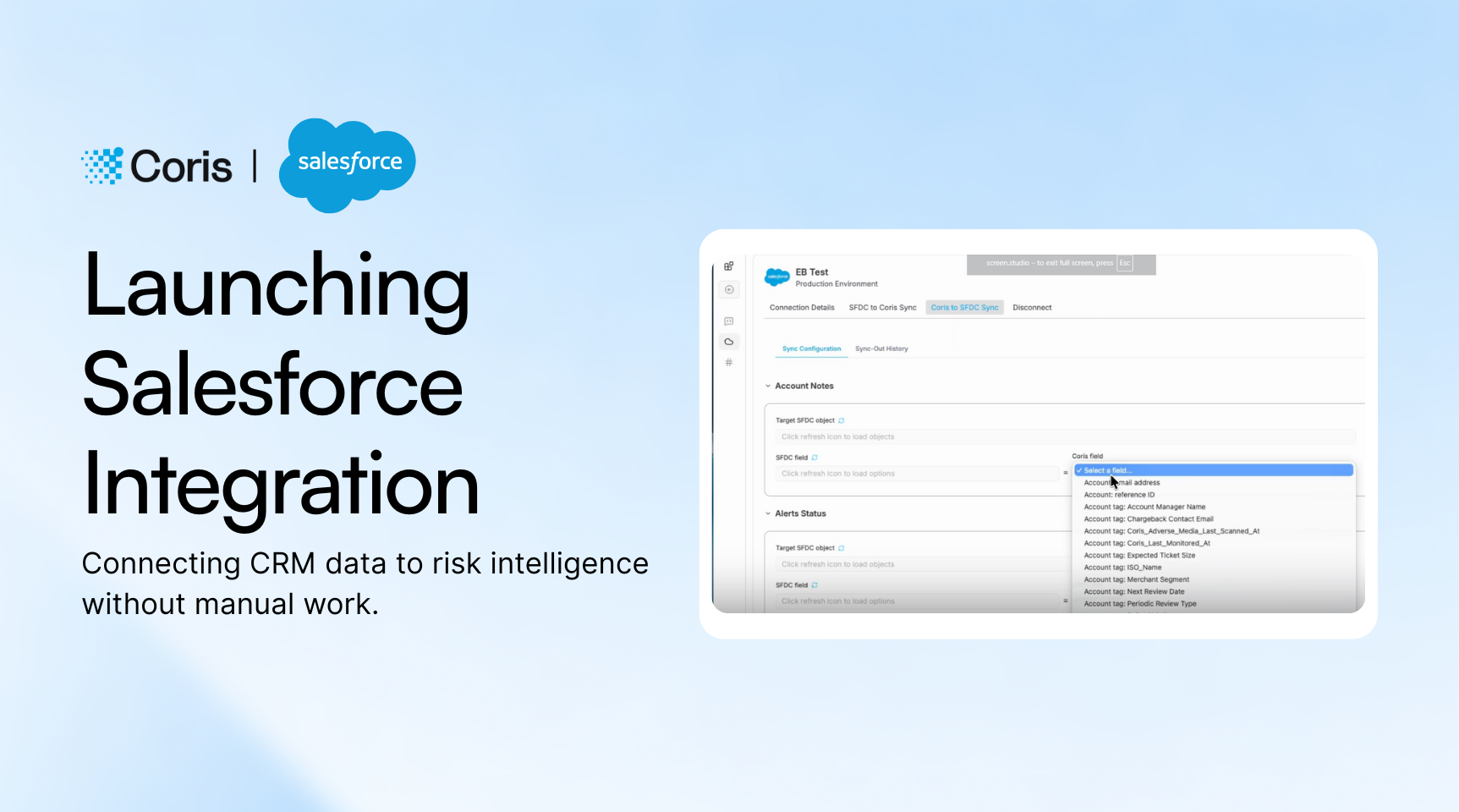
Coris now connects directly to Salesforce, allowing teams to pull merchant and opportunity data into underwriting and sync risk decisions back automatically. Faster onboarding, fewer manual updates, and a shared source of truth across sales and risk.

Salesforce is by far the most popular CRM and where many commercial teams already operate. It is where deals are tracked, account history lives, and customer communication is managed by a lot of the teams. However, risk and underwriting teams don’t always directly use Salesforce but still have to access it for information or keep it updated from a data hygiene standpoint.
Until now, bringing that information into risk platforms such as Coris required copy and paste work, shared links, or duplicate entry. This slowed underwriters and risk analysts and increased manual effort as merchant volume grew.
Our new integration changes that.
Coris can now pull new merchant and opportunity records directly from Salesforce, which means risk workflows begin with the context that already exists in their CRM. Underwriters can see sales notes, expected volume, use case information, and history without switching tools.
Also, as decisions are made in Coris, updates can flow back into Salesforce automatically. Status, data fields, and notes stay aligned without anyone typing the same information twice.
The result is faster onboarding, cleaner communication between teams, and a shared view of the merchant from first conversation to approval.
We have built a native integration between Coris and Salesforce so information can move in both directions without engineering work. With this integration, Salesforce admins at our customers can connect their Salesforce instances to Coris through a simple OAuth and configure the mapping between Coris and Salesforce.
Once connected, Coris can pull context from Salesforce and push risk outcomes back, all in real time.The integration is designed for two groups:
Customers do not need to involve their engineering teams. A Salesforce admin can:
After that, Coris can read and write data within the scope of the integration.
Once connected, Coris can use Salesforce as a source of merchant and opportunity data.
Example uses:
This gives risk teams a richer view of the merchant from the moment an opportunity is created.
The integration also works in the other direction. Coris can write data back to Salesforce so sales and operations stay current without manual updates.
Customers can:
Example uses:
This removes duplicate work and keeps everyone looking at the same version of the truth.
A new opportunity is entered in Salesforce. Coris’ AI agent pulls the record, creates a merchant profile, enriches it, and routes it into underwriting. Status updates sync back automatically so sales can track progress without leaving Salesforce.
Result: Faster onboarding and fewer manual handoffs.
When a risk rule fires in Coris, the event can be surfaced in Salesforce for account visibility. Case automation for Salesforce is coming next, enabling real time merchant notification and case creation without manual tickets.
Result: Shared awareness during critical events and less work stitching systems together.
Disputes surfaced through processors like Stripe or Adyen appear inside Coris. Salesforce can receive updates so operators do not maintain those timelines in two places.
Result: Fewer missed follow ups and consistent communication across teams.
The Salesforce integration is designed to remove friction in how commercial teams and risk teams work together.
With both systems in sync:
Coris remains the core system for risk evaluation, but Salesforce is now connected to it in real time.
Phase one supports bidirectional field sync, opportunity to merchant creation, and underwriting visibility across systems.
Next we are working on:
As these ships, teams will automate more of the operational lift around onboarding, event handling, and communication.
The outcome is simple. Less time moving information. More time making decisions.

Follow us




.svg)